Life, Even At The End

Yesterday morning as I cleaned up the breakfast dishes and prepared dinner to go into the crock pot, I listened to NPR, just as I do most mornings. The Diane Rehm Show, with which I frequently disagree but which I nonetheless enjoy, was devoting its 11:00 hour to a discussion on assisted suicide.

Now, I earnestly believe that life is precious and worthy of protection from conception to natural death. And I believe that it is so regardless of an individual’s age or health or wealth or mental capacity. So I knew I would find the conversation disturbing. But I figured it would be good to take in anyway: I think there is an inherent good in hearing an argument fleshed out, whether or not I agree with it.

But about half-way through the program, the conversation got to be too much for me. It was indeed disturbing to hear a cancer patient ponder when her life would no longer be worth living, to hear the story of a 90-year-old-man who so wanted to die that he first tried overdosing on pain medication, then slitting his wrists, and then he shot himself.

Horrible, horrible.

Yes, yes, it’s good to hear an argument fleshed out. But it’s not good to go through the day with a lurking feeling of gloom, when I have little boys to feed and care for and love. So I turned off the radio. I chose peace over enlightenment.

A moment later, during a quick perusal of my Facebook feed, I came across the following video*. (I can’t embed it, so do be sure to click on the link and watch the first three-and-a-half minutes or so. I promise it’s worth it.) The video provides a brief glimpse into the work of the Little Sisters of the Poor. Or maybe I should say the joy of the Little Sisters of the Poor, because that’s really more like it. The video follows the Sisters, whose mission it is to care for the elderly poor, as they throw a small birthday celebration for an older priest. It includes a joy-filled Sister offering wine and happily telling how they were gifted with extra cases of beer. It shows another talking about why they do what they do:

“We celebrate the gift of life, the joy of living. When we care for the elderly poor, we try to make them happy in whatever way we can and sometimes that’s through parties, it’s through good care, good food. It’s love, attention.”

I was struck with the stark difference between the two pieces of media I had just consumed. In one, there was an over-arching sense of death and hopelessness. In the other, there was life and joy.

Yes, of course, the Little Sisters of the Poor video captured a birthday celebration; it didn’t show the Sisters caring for a desperately ill, horribly uncomfortable person. It didn’t show them holding vigil at a deathbed. But the Sisters do those things too. They do them day in and day out; they see more of age, of illness, of poverty, of death than most of us ever will. Yet they are filled with joy.

I have a friend who is a Sister in another order, who worked for a time in a nursing home. She often posted on Facebook about waiting with residents who were nearing death. Sister would sit at their bedside, talking to them and praying for them. She made sure they didn’t have to die alone.

That type of ministry touches me deeply. I think about my life, about all the people I have interacted with and known and loved and I wonder, who will be with me at my last moment? Will anyone be there at all? Lots of people state the vague, “I want to go in my sleep,” but I don’t know that that matters much. I just hope I have someone with me to hold my hand and pray for my soul.

As a Catholic, I recognize that suffering is part of life. I don’t mean that it’s not significant or difficult. I certainly don’t mean that God wills it. And I don’t mean that it’s wrong for a person to want their suffering to end. I only mean that we do ourselves a disservice when we think suffering makes life “not worth living.”

Our society pounds into us, again and again, this idea that life is for the healthy and the happy. And I’m not just talking about bright, shiny magazine spreads. I’m talking about the things we do in our homes and say to each other: We put our animals “to sleep” when they decline in health or ability; we recite a litany of “I don’t care if it’s a boy or a girl, so long as it’s healthy;” we jokingly ask others to put us out of our “misery;” we tut-tut others’ pain when they mourn a miscarriage or the loss of someone very old or very ill. (Seriously, would you ever say “Well, I suppose it was just his time” to the parent mourning the unexpected death of an 8-year-old boy or the widow reeling from the loss of her 32-year-old husband?)

Given all of this – this idea that a life’s value is measured by its vigor – it can be easy to act like very old or very ill people’s lives have ended before they’re actually dead. It can be easy, even, to want them to be actually dead. I won’t claim to be immune from such thoughts.

But I don’t think the Little Sisters of the Poor fall into that trap. Where others see nothing but pain and suffering, the Sisters see lives with as much dignity as those of the healthy and vigorous. They remember that our value does not depend on what we can do or how we feel.

Our lives are always worth living. When I near the end of my own, I hope I’m surrounded by people who remember that.

LITTLE SISTERS OF THE POOR MISSION, VISION and VALUES 2012

The Little Sisters of the Poor are an international congregation of Roman Catholic women religious founded in 1839 by Saint Jeanne Jugan. Together with a diverse network of collaborators, we serve the elderly poor in over 30 countries around the world.

Continuing the work of Saint Jeanne Jugan, our MISSION is to offer the neediest elderly of every race and religion a home where they will be welcomed as Christ, cared for as family and accompanied with dignity until God calls them to himself.

Our VISION is to contribute to the Culture of Life by nurturing communities where each person is valued, the solidarity of the human family and the wisdom of age are celebrated, and the compassionate love of Christ is shared with all.

Our VALUES

REVERENCE for the sacredness of human life and for the uniqueness of 
each person, especially those who are poorest and/or weakest. This is 
reflected in care that is holistic and person-centered.

FAMILY SPIRIT: a spirit of joyful hospitality embracing all with open arms, 
hearts and minds; fostering participation in the life of the home and rejecting 
all forms of discrimination.

HUMBLE SERVICE: the desire to raise others up and to put their needs before 
our own; an appreciation of simple, everyday tasks and experiences and humble 
means in accomplishing our work.

COMPASSION: empathy for sharing the weaknesses and sufferings of others; 
eagerness to relieve pain in all its forms and to make the elderly happy.

STEWARDSHIP: the recognition that life and all other goods are gifts from God
 and should therefore be used responsibly for the good of all; trust in God’s Providence 
and the generosity of others to provide for our needs; just compensation for our
 collaborators; a spirit of gratitude and sharing.


* I came across the video because the Little Sisters of the Poor were recently named to NOW’s “Dirty 100” (oh, the irony) list of organizations that have filed suit against HHS regarding the contraception mandate. See my last post for a few of my thoughts on that subject.

Crime and Punishment and Moving On

A This American Life episode from a couple of weeks ago tells the story of Mike Anderson, a married, suburban St. Louis father of four. Mr. Anderson owned a contracting business and built his family’s home from the ground up. He volunteered at church and coached his son’s football team. In short, he was a responsible, productive member of society.

But he had a secret. And one morning last summer, while Mr. Anderson was home alone with his two-year-old daughter, with his wife away on a business trip, a hard knock on the door brought his secret to light.

In 1999, when Mr. Anderson was 22 years old, he and a friend held up a Burger King manager while the man was making a night deposit at a bank. Mr. Anderson says he got “caught up with the wrong crowd that night.” He had no prior convictions and a full-time job. He said the robbery wasn’t his idea and that his friend’s weapon was just a BB gun. (It was never recovered.)

Nonetheless, Mr. Anderson was convicted of armed robbery and sentenced to 13 years in prison. He was out on bond filing appeals when the court ultimately determined that he did indeed have to serve his sentence. Mr. Anderson waited for a warrant to be issued so the police would come take him to prison. But it never happened. They didn’t come.

Due to a clerical error, the court had been informed that Mr. Anderson was already in prison. It wasn’t until 13 years later, when the system was preparing for his release, that they discovered he’d never been there at all. So they finally came for him.

In the meantime, Mr. Anderson had gone from expecting to be picked up at any moment, to thinking maybe it would never happen, to deciding to turn his life around. He went back to school and became a master carpenter. He married and became a family man. He never had another run-in with the law.

In the words of the segment’s narrator, “Thirteen years without going to prison did exactly what you’d hope 13 years in prison will do for a person: Mike reformed, became a model citizen. Which raises the question, do we want to send him to prison? It’ll cost the state of Missouri about $20,000 a year to house and feed him. And if Mike’s no longer a danger to society, what’s the point of having him sit in a cell when he could be out working, paying taxes, and raising his kids?”

As Mr. Anderson’s story has become known in the St. Louis area, many people have come to the opinion that if he’s been rehabilitated, he shouldn’t have to serve his prison sentence. Surprisingly, perhaps, one such person is the victim of Mr. Anderson’s crime. The victim, who was deeply impacted by the crime, was initially angry when he learned that Mr. Anderson didn’t serve his sentence. But thinking more on the situation, he has come to believe that what the State is doing to Mr. Anderson isn’t right. He says, “Yeah, he screwed up when he was little, but the law dropped the ball; the law ought to drop it completely. They need to leave the man alone.”

198855_10150124008738781_3583982_n

Sorry — I know this photo isn’t exactly pertinent to the post’s subject matter. But it’s the only behind-bars shot I’ve got. And These Walls IS about 90% mommy blog.

Mike Anderson’s story reminded me of a subject I’ve thought on for years – one on which my thoughts have most definitely evolved: What purpose do criminal sentences (namely prison terms) serve? Are they meant to be punishments, pure and simple? Are they meant to protect the public from dangerous individuals? Are they meant to rehabilitate criminals so they can be successfully returned to society?

It is my nature to view crime and punishment in very simple terms: If you commit a crime, you deserve to be punished. Period. (I’m a strong “J” on the Myers Briggs scale.) I remember thinking as a teenager, “If you do something wrong, you deserve whatever you get. Whatever you get.” I was in favor of capital punishment, three-strikes laws, building more prisons – you name it.

Over time, however, my thinking has changed… grown… become more nuanced. It’s become at once more compassionate and more practical.

The changes started with capital punishment. On that particular topic, my Catholic faith had a strong influence in changing my mind: statements from Pope John Paul II and lunch table conversations with seminarian friends ultimately convinced me to be more humble in my considerations. I went from thinking, “If you murder, you deserve to be killed,” to “It’s not so much about what murderers deserve as it is about what we choose to do with them.”

I later came to apply that thinking to the subject of crime and punishment in general. I figure that it’s never up to me to determine what someone deserves – that task is for God alone.

It is, of course, up to society to determine the best ways to keep its population safe and to prevent crimes from occurring in the future. And I think that is where our focus should be when considering crime and punishment. It’s not up to me (or people in general, and therefore the State) to dole out punishments simply for the sake of punishing. It’s up to us to be intelligent and deliberate about dealing with the fallout from crime and figuring out the best ways to prevent it from perpetuating.

Tragically, our criminal justice system does a terrible job of this. Small-time offenders leave prison with (1) fewer prospects for gainful employment than they had before establishing their criminal record and (2) experiences and contacts that better equip them for a life of crime than for anything else. No wonder recidivism rates are so high.

I think we need to be more practical about what we do with those found guilty of crimes. It’s one thing if someone has committed a crime that will earn him or her a sentence of life without the possibility of parole. (Which is, I think, what we should choose over capital punishment. For one, because taking a life is a grave, grave matter that should be avoided whenever possible. For another, because people should be given every possible opportunity to repent of their sins.) It’s quite another thing if a person’s crime will earn him or her a temporary prison sentence.

If a criminal is to be returned to society someday, then society should do everything possible to ensure that he or she re-enters it prepared to function legally. Crime should not be ex-offenders’ only real prospect for survival. They should be able to work, to earn, to contribute, to thrive. Everyone will be better off when a criminal can complete his or her sentence and then move on.

I’m not naïve; I know such a situation would be terribly hard to achieve. (And it will never be perfectly achieved.) Employers are (understandably) unwilling to hire people with criminal records. Solid communities are largely unwilling to take them in; subversive communities are all too willing. And people are imperfect. Some will continue to do wrong no matter how much assistance they are given.

But I think it’s worth trying.

Sentencing guidelines, prison conditions, hiring policies, resources for ex-offenders: they’re all areas where improvements can be made. And indeed the status quo on sentencing and prisons, at least, is in many cases currently doing more harm than good.

Just think of Mike Anderson. His business, his home, his children would not be here if he had reported to prison 13 years ago. He would not have paid taxes and contributed to the economy. He would not have been able to volunteer at that church or coach that team.

How many more empty spaces do we have today — ghosts, you might say, of those sitting in prison – spaces in our economy, our neighborhoods, our families, our communities, where people could be contributing rather than serving prison terms that harden and debilitate them?

As far as Mike Anderson is concerned, his attorney has filed a brief arguing that when the State forgot about Mr. Anderson for 13 years, it violated his right to due process or speedy punishment. If the effort fails, his only recourse is to petition Missouri’s governor for clemency. The governor has only granted clemency once. I pray that Mr. Anderson’s case prompts him to do so again.


This is post two of the 7 Posts in 7 Days challenge at Conversion Diary. Stop there to check out the hundreds of other bloggers who are also participating.

Some Monday Musings On… Death (Yes, Death)

—1—

I’m (kind of) picking up my “Monday Morning Miscellany” idea again here because I’ve got another case of I-had-plenty-to-put-in-a-7-Quick-Takes-Friday-but-couldn’t-stay-awake-to-write-it. I don’t know whether it’s my schedule lately or the fact that I’m moving deeper into the third trimester, but I can’t remember the last post I wrote that I didn’t fall asleep on at some point. Including this one.

Hmm… and I wondered where these boys got it…

P1170891

P1170927

But this Monday’s collection of miscellany didn’t turn out to be so miscellaneous after all. As I started writing, I was surprised to realize just how much of what’s on my mind right now pertains to death. (Yes, DEATH.)

So here I go with some sober musings for this Monday: tragic deaths at the Mall in Columbia, the sadness of a death in the family, an NPR piece on a “death class,” remembering an experience at a cemetery in Ireland, the delicate task of explaining death to very little ones, and the (BIG) question of life after death.

What a cheerful way to begin the week!

—2—

I’ve got to start with this weekend’s big, awful news from our corner of the world: three people (including the shooter, it seems) were shot and killed inside the Mall in Columbia. It’s yet another senseless, heartbreaking episode of violence to splash across the national headlines. But this one is ours.

This is the mall we typically go to. I’m not familiar with the exact store where those poor people were killed, but I know that it’s very near the store where I buy my boys’ shoes… and the Starbucks I stop in for a pick-me-up… and the carousal my boys love to ride at the beginning of our shopping trips. So this one hit home.

Even so, (and I hate to say it) I reacted to the news with resignation. I was nervous to know whether any of my loved ones were at the mall and in harm’s way; I was concerned for all who were there at the time, whether I knew them or not. I prayed. I worried. But I wasn’t as surprised as I might have been. And my reaction was not as dramatic as it might have been.

The fact is, we’ve had enough of these tragedies in the U.S. in the past few years (not to mention the multitude of horrors that have happened abroad) that they’re no longer surprising to me. Even, apparently, when they’re in my own back yard.

The fact is, these tragedies lurk in my mind just about every time I head out in public – and certainly every time I head to the mall. That mall. For years now, I’ve walked into that mall aware that something like this could happen. So I only go when I have a particular errand I need to accomplish. I don’t stay long. I look around for exits. I think up strategies to keep my children as safe as I can.

Isn’t that awful?

It is. It’s sad. It’s a shame. But it’s simply an acknowledgement of the world we live in. And it’s only an echo of how so many people in other parts of the world live every day: in insecurity, in fear, perhaps in resignation. It is what it is.

—3—

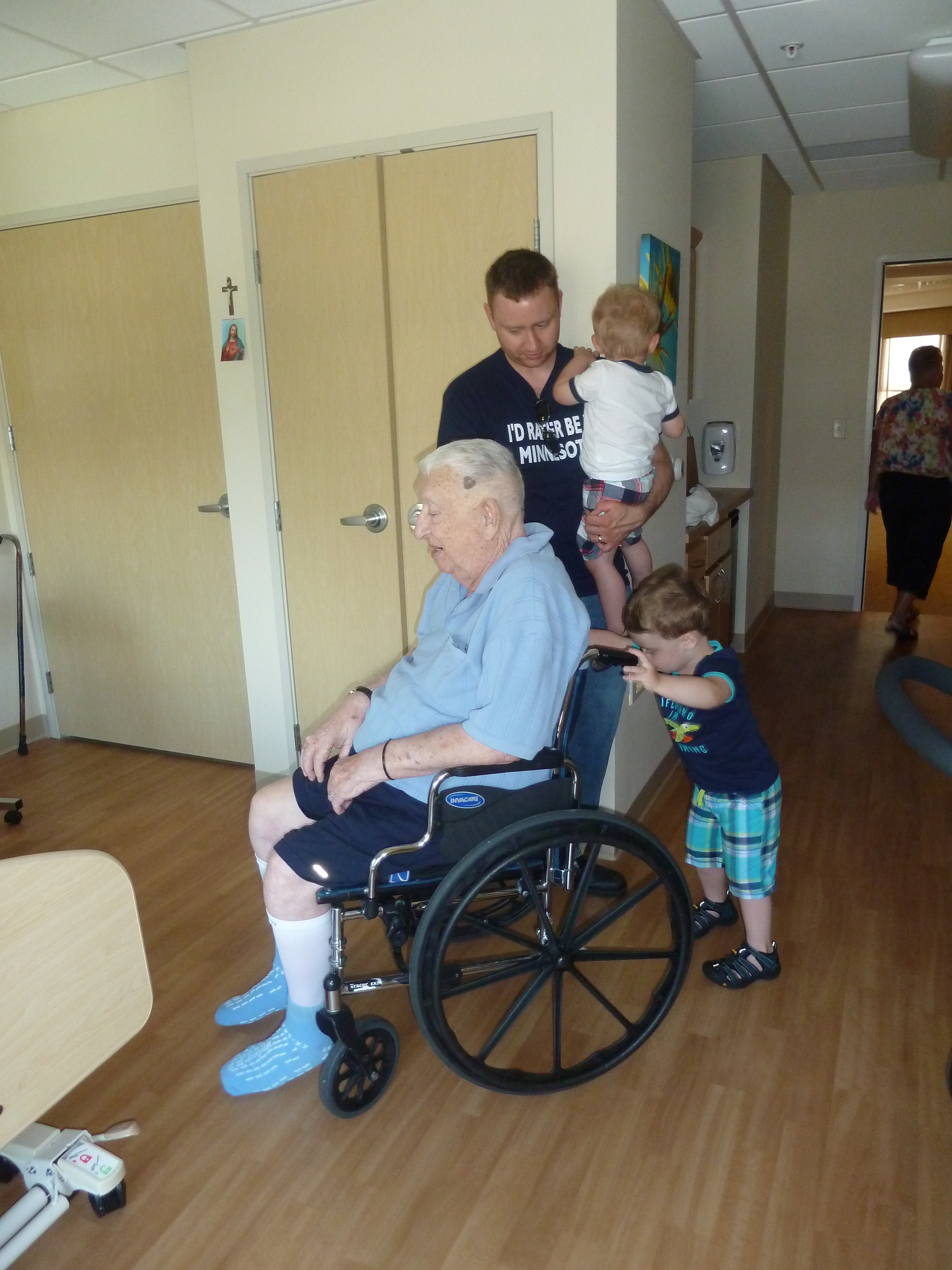
It’s been a sad couple of weeks at our home, all-around. Two weeks ago yesterday, my husband’s stepfather died.

Brennan’s parents divorced when he was 10 or 11 years old and his mother remarried a couple of years later. Then when Brennan was barely 14, his father died. Similar situations have probably made for more than a few challenging stepfather/stepson relationships. But fortunately for our family, that’s not what happened with Ed and Brennan.

Brennan recalls his father’s memory with fondness and I know he wishes that he could have gotten to know him better. But he’s also very grateful for Ed’s presence in his life. I am too. Ed is the man who taught my husband about responsibility, about devotion to his wife, about a million little practical things that people need to learn in order to be independent adults. Brennan attributes part of who he is today to the lessons he learned from Ed.

As I mentioned over the summer and again on Veterans Day, Ed was a veteran of World War II who fought in the Battle of the Bulge and was wounded just before the war ended. I wrote then:

With my own parents still in their ‘50’s, it was more than a little difficult for me to get used to having a (step)father-in-law who is a member of the “greatest generation.” And I have to admit that, having seen him only once or twice a year for the past six years, I don’t know Ed very well. But I know that my husband loves and respects him. And I know that he has lived a long and interesting life, with his fair share of pain.

Some of it, of course, can be traced to his service in that awful war. Shortly before it ended, Ed found himself in Passau, Germany. In trying to rescue his sergeant, who had been shot, Ed was himself shot in the lung and the arm. He earned the bronze star for his actions. And he has lived with the repercussions of his injuries ever since…

Whenever I see an elderly person, particularly one who looks weak or ill, I wonder what kind of a life they’ve lived. I wonder at the events and the change they must have seen in their lifetime. Whenever I see an old man wearing one of those hats that veterans wear – the kind that denotes the ship they served on – I envision the young, strong man he must have been. I don’t know what to say or do, except to show a little kindness and maybe a little love. I want to ask, but I don’t want to intrude. I want to thank, but I don’t want to sound trite. So mostly I just wonder. And I say a little prayer.

With Ed, I know something of his story. But I still don’t know what to say. So I show some kindness and some love. I give him a hug and a kiss. I encourage the boys to do the same for their “Baba Ed.” Every once in a while, I have the boys color him a picture and we stick it in the mail. And I pray.

Ed had been seriously ill for some time and confined to a nursing home for a couple of years, so his death didn’t exactly come as a surprise. Still, it is an ending, and it is sad. It’s downright heart-breaking for Brennan’s mother, Hilde, who loves Ed with an attachment and a devotion that I’ve seldom witnessed.

So if you’re the praying type, we would greatly appreciate a few prayers at this sad time: for the repose of Ed’s soul, for comfort and strength for Hilde, and for peace for Ed’s children, step-children, and grand-children. Thank you.

P1150669

—4—

I heard a fascinating piece on NPR last week. It was about a college course on death. Students in the class visit a funeral home, a cemetery, and other places that deal with death on a regular basis. They learn and talk about death in its most physical, scientific senses and also in more abstract, emotional ones. They talk and think about their own personal experiences with death.

What an idea.

We’re fortunate to live in a time and place where we can go years – maybe most of our lifetimes – without having an intimate experience with death. Due to good sanitary conditions, abundant food, and advanced medical practices, we can go through our lives expecting that we’ll make it safely through our own births, our childhoods, our sometimes-wild youths, our pregnancies and deliveries, our illnesses, and even our advanced years.

This is an incredible blessing. Yet is also removes us from one of the most basic realities of life: all of us will die. You, me, those we love – all of us.

So when we do encounter death, I think it can be rather more shocking and damaging to us than it’s been to those who have lived throughout most of human history, those who were more used to death than we are. I think it can also contribute to a lack of appreciation for just how precious life is.

Maybe it’s something we should work on.

When my husband and I were in Ireland for our honeymoon, we had the incredible opportunity to visit with some of his father’s cousins, who still live there. (Brennan’s grandfather came from Ireland.) Most unfortunately, one of the cousins had died just days before, from breast cancer. I believe she was in her early ‘50’s. We were fortunate enough to be able to pay our respects at her grave, as well as those of Brennan’s great-grandparents. While in the cemetery where his cousin had just been buried, we saw a young woman drive up, hop out of her car, walk over to the cousin’s grave, leave a flower, and pause for a few minutes in prayer. She then proceeded briskly away.

I was struck by the experience. How often do we see (or do) that here? Sure, we’re somewhat familiar with cemeteries from the burials we’ve attended. And if we’ve lost someone we love dearly, we may make repeat trips to visit their graves. But do we make such a practice common? Do we make a quick stop at the grave of a friend or acquaintance on a random Thursday, just to pray and pay our respects? When I remarked on the young woman’s visit, another of Brennan’s cousins said that such behavior is common in those parts, even for young people. She said something to the effect of “For the Irish, death is a very real and present thing.”

—5—

Ed’s death, of course, has prompted us to talk about death with our boys for the first time. Our two-year-old seems oblivious to the discussions, but our three-year-old has had a lot of questions: “Will I die? Will you die? Is our cold yike Gwanpa Ed’s?”

It’s been interesting and a little scary to answer his questions. It’s a challenge to explain death in a way that a three-year-old will understand, without making such a sensitive little guy too nervous. I keep having to tell him that yes, we will all die someday. Everything that lives will die. But Grandpa Ed was very old and very sick, and we are neither of those things. Hopefully we’ll all live a long, long, long, long, long time yet. And no, Grandpa Ed did not have our cold.

I’m also having to make my attempts at explaining to him what happens to people after they die. I know that a lot of people will tell their children (and really, often themselves) that when the people we love die, they go straight to heaven and become angels that will watch over us. But I see that as an over-simplified, fairy-tale kind of explanation. I don’t want to feed it to my children now, only to disabuse them of it when they’re older and starting to wrestle with moral questions. Because I don’t think heaven is a given for anyone.

I’m Catholic, and though I am no theologian, I think I’m in-line with Church teaching when I say that heaven and hell are not assigned to us “at the pearly gates.” And they’re certainly not assigned as popular culture seems to: everyone we love gets into heaven, while everyone who’s really, really bad, like murderers and child abusers, goes to hell. I think that if we’re truly close to God, we get to be with him after we die, and we call that heaven. If, however, we’ve removed ourselves from God, we are without him after we die, and we call that hell. I also believe that prayers count, even for the dead. I believe that it’s worthwhile to pray for our beloved dead, that they may become ever closer to God. I hope people will do so for me when I die.

So, what do I tell my boy? I tell him that we really hope that Grandpa Ed gets to be with God in heaven. And I invite him to pray with me to that end.

—6—

Somehow, I don’t think that’s quite the way to end this post. So let me just draw your attention back to that NPR piece: “‘Death Class’ Taught Students A Lot About Life.” I hope you’ll follow the link and listen to the story. It’s just five and a half minutes long. Perhaps it will pique your interest, like mine, in reading journalist Erika Hayasaki’s book about the class: “The Death Class: A True Story About Life.” And perhaps it will cause you, like me, to ponder death for a little while — your reactions to it, your fear of it, your appreciation of it (and therefore of life), what you think will come of it…

As repulsive as the subject might initially be, death isn’t really such a bad thing to think on for a bit. It seems like a worthwhile investment to me, at least.

Tiny Conductor

Last week at my church choir practice, I was reveling in being part of a choir again. I was enjoying having to stretch my brain to achieve something. I was getting a kick out of adjusting my voice just so to fit in with everyone else’s. I was feeling competent.

Then last night, I took my two toddler sons with me.

It was a cold, rainy night. Past their bedtime. I am brilliant, let me tell you.

Yes, the two-year-old screamed and cried when we got there because he wanted to go home, to bed. (I felt like a terrific parent.) Yes, my fellow choir members kept having to fish the boys’ cars out from under chairs. Yes, the boys made a game of throwing their coats at each other as hard as they possibly could. Yes, they ultimately ended up in a rolling, writhing heap, wrestling at the choir director’s feet. Yes, I had to pry their screeching heads out of each other’s clutches.

But let’s not dwell on those mishaps. Let’s focus, instead, on the few moments when no one was screaming or throwing or wrestling. I didn’t notice it at first, distracted as I was by the two-year-old on my lap, but my older son was trying his hand at directing the choir. He was standing several feet away from our actual director, miming her motions. There was a very serious look on his face. Undoubtedly, the looks on the choir members’ faces were less so.

As the music went on, he got more and more into it. His arms started to flail. He began to jump and dance a little. Then the music really overtook him. He ran up the few steps onto the altar. With every big note we hit, he jumped down a step – still flailing his arms and dancing around. When he got to the bottom, he’d race back to the top to start all over again.

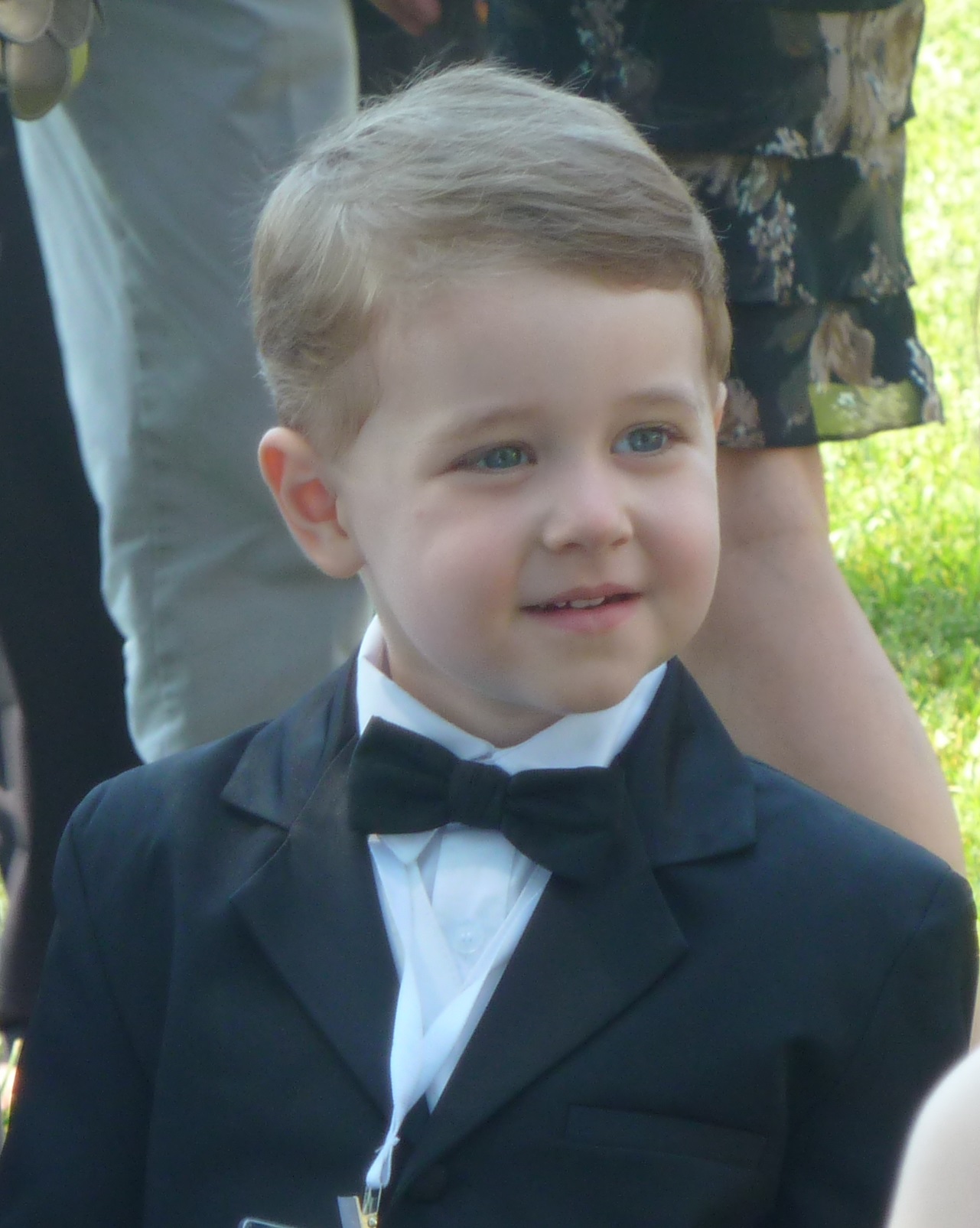
It was like watching some miniature, wild-looking orchestra conductor. If I’d just brought him in his little tux and had a crazy wig to stick on his head, the picture would have been complete. (As it was, he was wearing footie pajamas.) It was all I could do to stop myself from breaking down into a giggling, laughing, snorting mess. And I’m his mother; I’m used to his shenanigans. I don’t envy our (real) choir director at that moment. She had quite the competition.

Ring Bearer

The evening was stressful and exhausting for me. If I’d been a little more self-conscious, it would also have been embarrassing. But our director (a mother of six) and my fellow choir members couldn’t have been nicer about it. There were lots of mentions of their own children and grandchildren, there were lots of comments about how cute the boys are, and there was a reminder that, “Jesus said to let the little children come to him!” Those good people even (gasp!) said that the boys had done well.

Sure, I was bone tired by the time I got in the car to head home. Sure, I resorted to rewarding myself with a chocolate-peanut-butter sundae on the way home. (Yay for ice cream shop drive-thru’s!) Sure, I sat in the driveway until my husband returned home from work and I let him carry the boys inside and to bed.

But overall, I was left with thankfulness for the people we had just been with. And for the larger Catholic culture they represent: a culture that delights in people, in children, in new life. One that recognizes that real people are wonderfully imperfect. One that greets a couple of rowdy, excited toddlers with love and offers their worn-out mama words of comfort.

I was also left with that happy image of my boy delighting – powerfully, physically – in music. This child who makes up songs all the time, who sings loudly and proudly, even when it’s just gobbledygook coming from his mouth. This child who wants, more than anything else, a guitar for Christmas. I wonder how his love for music will factor into his life as he grows. Yet again, I wonder what kind of an adult he will become.

Given the stress I’d been under just a couple of hours before, these weren’t such bad thoughts to be ending my evening with.

The Religious Climate In My Here And Now

I was happy to see that Jen of Conversion Diary was revisiting her “religious climate” questions again this year. I always find the variety of answers she gets to be fascinating. (I’ve just realized that I always italicize the word “fascinating.” It doesn’t seem to work for me any other way.)

I’m not sure how fascinating my answers will be to anyone, as I live in the good ol’ U.S. of A. just like the majority of Jen’s readers, but I thought I’d tackle them nonetheless. Because I really like pondering questions of how religion and society interact.

First, let me (1) characterize my own little corner of the world, and (2) emphasize that this characterization, and all of the answers below, simply reflect my sense of my corner. I wouldn’t be at all surprised if one of my neighbors or relatives reacted to it with, “Where the heck are you? It’s not like that where I live!”

Just like so much of the United States, my State is distinctly divided along cultural/political lines. We have some very liberal areas and some very conservative areas. We have urban areas and rural ones. We have great wealth and real poverty. We have wealthy/intellectual liberal, urban/poor liberal, rural/suburban conservative. And the factions don’t always mix very well.

Too often, they quite purposefully don’t mix at all. Or if they mix in one sphere (say, the workplace), they feel like they have to keep their political/cultural/religious sides to themselves. It’s quite possible for the conversation in #3, below, to be very comfortable and friendly in one setting and extremely uncomfortable – maybe even laughable – in another. Same place; different mix of people; very different outcomes.

 20131006_152058

1. WHERE DO YOU LIVE?

In the greater Washington, D.C. area.

2. WHAT IS CHURCH ATTENDANCE LIKE? ARE THERE MANY CHURCHES?

There are lots of churches. Catholic churches in suburban areas seem to be full. Most of the parishes I’ve attended have been standing-room only for the main Sunday mass(es), less full at Saturday and early-Sunday-morning masses. They’ve had anywhere from 3 to 12 masses per weekend and their sanctuaries have probably averaged 500 seats. That adds up to lots of people.

That said, Christmas and Easter masses seem to draw at least three times as many attendees as “regular” Sundays. They necessitate additions to the mass schedule and/or the addition of an improvised worship space (i.e. a school gym). Which tells me that if all the Catholics in my area actually attended mass on a weekly basis, we’d need to get very busy building churches.

In short, Catholic churches seem full, but for every active Catholic, there must be several more who rarely or never attend mass.

Mainline Protestant churches seem smaller and (from my limited experience) emptier. Evangelical churches seem to have bigger, fuller parking lots, so I’d guess they do better in the attendance department. We also have some (not lots) of “mega-churches,” of which I know little.

We also have a fair number of houses of worship for people of faiths other than Christianity. Our region has so many people from other parts of the world, we’ve got members of just about any faith you can imagine.

3. HOW APPROPRIATE WOULD IT BE FOR A PERSON TO ACKNOWLEDGE THAT HE OR SHE IS A BELIEVING CHRISTIAN IN CASUAL CONVERSATION?

Per the above, it depends. It would probably always be minimally acceptable. In some parts it would be accepted and encouraged; in others it would seem strange or even inappropriate.

4. WHAT KIND OF FAITH DO THE POLITICIANS CLAIM TO PRACTICE?

We have politicians of different faiths. Most would claim some faith; few would claim none. But even those who claim a faith in common with their constituents would be unlikely to talk about it too widely.

5. HOW COMMON WOULD IT BE TO SEE A FAMILY WITH MORE THAN THREE KIDS? WHAT ARE THE ATTITUDES TOWARD FAMILY SIZE?

Two to three children is considered normal; four is still mostly “acceptable.” Any number over that – or even three/four if they’re spaced closely together – is usually viewed as strange.

6. WHAT WAS THE DOMINANT BELIEF SYSTEM IN YOUR AREA 50 YEARS AGO? WHAT IS IT NOW?

My sense is that 50 years ago my area was more culturally and religiously conservative, if not politically. People were likely more church-going than they are now. There were far fewer religious minorities, but there was still a good mix of Catholic and Protestant Christians.

But that “mix” would have been in the broad sense. I’m under the impression that people of different faiths are much more comfortable with each other now than they used to be. I think the Catholic and Protestant communities were much more distinct and divided 50 years ago. My (Catholic) grandmother still vividly remembers a terrible experience from her childhood, when her (public) elementary school teacher in a predominantly Protestant rural area went on an anti-Catholic rant in class.

Per my answer in #2, there is much religious diversity. Still, Catholic and Protestant Christianity predominate.

7. DO THE PEOPLE WHERE YOU LIVE SEEM HAPPY WITH THEIR LIVES?

Given the current political stalemate in Washington and how dependent our local economy is on the government (many friends are furloughed right now), people don’t seem too happy at the moment. More broadly, I still sense a general unhappiness/sadness/frustration. Even if one’s own family has survived the economic (and political) crises just fine, they’re likely to have friends or family who haven’t.

Thanks for the great questions, Jen! I look forward to seeing what everyone’s got to say!

On Abortion: Paul Ryan and Two Simple Questions

Almost a year ago, I was watching the Biden/Ryan Vice-Presidential Debate on television when the following exchange occurred:

MS. RADDATZ: I want to move on, and I want to return home for these last few questions. This debate is indeed historic. We have two Catholic candidates, first time on a stage such as this, and I would like to ask you both to tell me what role your religion has played in your own personal views on abortion. Please talk about how you came to that decision. Talk about how your religion played a part in that. And please, this is such an emotional issue for so many —

REP. RYAN: Sure.

MS. RADDATZ: — people in this country. Please talk personally about this if you could. Congressman Ryan.

REP. RYAN: I don’t see how a person can separate their public life from their private life or from their faith. Our faith informs us in everything we do. My faith informs me about how to take care of the vulnerable, about how to make sure that people have a chance in life.

Now, you want to ask basically why I’m pro-life? It’s not simply because of my Catholic faith. That’s a factor, of course, but it’s also because of reason and science. You know, I think about 10 1/2 years ago, my wife Janna and I went to Mercy Hospital in Janesville where I was born for our seven-week ultrasound for our firstborn child, and we saw that heartbeat. Our little baby was in the shape of a bean, and to this day, we have nicknamed our firstborn child, Liza, “Bean.” (Chuckles.)

Now, I believe that life begins at conception.

That’s why — those are the reasons why I’m pro-life.

Now, I understand this is a difficult issue. And I respect people who don’t agree with me on this. But the policy of a Romney administration will be to oppose abortion with the exceptions for rape, incest and life of the mother.

Before I tell you my reaction, let me point out that you can find the whole transcript here. And you can watch a video segment on this part of the debate here. Ryan had a few more comments after the ones I excerpted, but they all dealt with Biden and the Democratic party. And of course Biden gave his answer to Raddatz’s question, which is another topic for another day.

Though it goes without saying, let me also note that abortion is a highly controversial issue and that there are plenty of very real, very important emotional elements to the debate over it. But like Biden’s answer, I consider those elements to be other topics for other days. In this here blog post, I want to stick to the basic logic at the heart of the debate. And I want to give my reaction to Ryan’s answer, which is:

FUMBLE

What a terrific opportunity he missed! Sure, the “bean” story was cute, but Ms. Raddatz asked a question that gets right at two of the most precarious fault lines in American political discourse: (1) abortion and (2) religious influence on matters of public policy. Here’s what I think Representative Ryan should have said:

Reason and science informed my understanding that life begins at conception. My faith taught me that life matters – that human life is valuable and worth protecting.

For all the angst and gray areas and moral confusion over the issue of abortion, I think the logic at the heart of the debate is really very simple. It involves answering two basic questions: (1) When does life begin? And (2) (When) does life matter?

Here’s my thinking on that first question:

  • Conception is the only dividing line to which you can look for a clear differentiation between being and not being, therefore it is the only logical point at which life can begin.
  • That is, on this side of the line we have an egg with Mom’s DNA and a sperm with Dad’s. On that side we have a new being, a “zygote” with half of the DNA from each. Never again in our development do we see such a fundamental change.
  • From that point on, our cells divide and multiply. We grow exponentially. But we do not, in essence, change. We do not require anything but shelter, nutrition, and time to develop into a form that is easier for our eyes to identify as human.

If you were not to define conception as the point at which life begins, at precisely which other point on the continuum of development would you settle on?

  • Are we not alive when we look like a simple cluster of cells but we are alive when the cells have organized themselves into a spine and brain and heart?
  • Are we not alive when we’re free-floating embryos, but we are alive when, a moment later, we attach to our mother’s uterine wall?
  • Are we not alive before a physician can detect a heartbeat, but we are alive once our heartbeat has been witnessed?
  • Are we not alive before the 24th week of our mother’s pregnancy (the point at which today’s medical technology is capable of keeping us alive outside the womb), but we are alive once we’ve reached that 24-week mark?
  • Were we alive at 24 weeks a hundred years ago, when we would have died from being born so early?
  • Are we not alive when we’re lodged in the birth canal, awaiting our final exit from our mother’s body, but we are alive moments later, lying in her arms?
  • Or, are we alive when our mother wants us, not alive when she doesn’t?
  • Does our life depend on our physiology, or others’ perceptions of us?

20130726_192855

Okay, that’s enough with that one. Let’s move on to the second big, basic question: When does life matter? Or perhaps even, Does life matter? As far as I’m concerned, this is really the crux of the abortion debate, as well as the other life-related controversies: capital punishment, euthanasia, how we view people with disabilities, etc. The real question regarding abortion is not so much, “When does life begin?” It is, “At what point do we think life is worth protecting?”

And that’s where we have to look really hard at ourselves.

  • First of all, do we even believe that human life is worth protecting? Do we have a rigid “survival of the fittest” mentality, or do we believe that there is something special about the human person?
  • Second, if we indeed believe that human life, in the broad sense, is worth protecting, then which individual human lives are we honestly thinking about? Are we thinking about those we love? Are we thinking about those with whom we share beliefs, culture, class, race, nationality? Those who seem able and good? Or are we also thinking of the “other”?
  • Third, if we believe that some human lives are worthy of protection and we’re also thinking of those who are unlike ourselves, then do we take the final step? Do we believe that every single individual is inherently worthy of life, just by virtue of being human?

If we can’t make that leap, where do we draw our lines? Do we draw them at age, at health status, at conduct, at convenience, at others’ desire for the individual? Do we draw them along those ancient lines of family, faith, tribe, class, etc.?

  • Is a life only worth protecting when s/he is at a convenient age, in good health, innocent of crimes, wanted by the people around her/him, and a member of a favored family/tribe/class/nationality?
  • Is a life worth protecting when a certain few of those conditions are fulfilled?
  • Or, is a life always worth protecting?

And what about those babies – those zygotes/embryos/fetuses – whatever you want to call them? Reason tells us that, from the day they’re conceived to the day they die, they’re alive. But at what point do we think they are inherently valuable and worthy of protection?

  • Are they worth protecting once they’ve reached a certain developmental stage? Once modern medicine is able to keep them alive outside the womb? When they were conceived through a consensual encounter? When – and only when – their mothers want them? When they are judged to be perfectly healthy and convenient?
  • Is a baby’s life worth protecting when a certain few of those conditions are fulfilled?
  • Or, again, is a baby’s life always worth protecting?

My Catholic faith – the one I share with Representative Paul Ryan – teaches that human life is always important. It always has value. It should always be protected. Rep. Ryan indeed got something right when he said, “My faith informs me about how to take care of the vulnerable, about how to make sure that people have a chance in life.” I don’t know enough about him to understand exactly what he means by “take care” and “vulnerable” and “make sure people have a chance.” But I know that the Catholic Church is eminently consistent in its message: People have a right to life, from conception to natural death. People also have a right to the basic necessities of life: namely food, shelter, and health care. (In my opinion, to advocate for one – the “right to life” or “social justice” – but not the other is to miss the point.)

I accept the Church’s teaching on the inherent value and dignity of life. As a Catholic, I believe that people are precious – every single one: The beautiful, treasured, long-wanted newborn in his mother’s arms; the unborn child of a woman contemplating abortion; the baby girl thrown away as trash because she was unfortunate enough to be born into a culture that favors boys; the child with a congenital disease or developmental disability; the frail person suffering an illness that will surely take her life; the person who committed a crime that not only irreparably hurt others, but also harmed his own soul. They all count.

Reason and science informed my understanding that life begins at conception. My faith taught me that life matters – that human life is valuable and worth protecting.

20130726_192927

Care to answer any of the dozens of questions I listed above? Leave a comment! And I do (cringe) really mean that.

Full Disclosure

As I plan to write about some political and religious issues on this blog, I thought it would be useful to provide a little background on the evolution of my outlook in these areas. (I have all these country songs running through my head as I write this: “Where I Come From,” “God blessed the broken road that led me straight to you,” etc.)

I thought this little ‘disclosure of my biases,’ as I think of it, would be useful for a few reasons: (1) Political and religious subjects can be pretty touchy. (No surprise there.) (2) Our opinions on them usually have a strong basis in our own life experiences. (3) I aim to be as fair, open, and even-handed on this blog as I can be. And (4) I personally prefer news and commentary sources that either (a) represent both sides of an issue equally well or (b) openly disclose their opinions and make no pretense of impartiality. So I kind of thought I’d cover all my bases.

But before I go any further, let me say that this post makes me nervous and I had a hard time writing it. (Which is part of the reason I wrote so few posts this past week. I was trying to take this one in a different direction and it stumped me.) The words below represent my past and my thought processes and my faith, family, and friends, and it’s all very personal. It’s also probably a big ol’ case of TMI. But I felt like I needed to get all this out there before I proceed with a bunch of other posts I have lined up in my head.

So…

I was raised Catholic in that I regularly attended mass with my mother and I was provided with a religious education through our parish. But my father is not Catholic and there was little mention of faith in our (very happy) home. These days when I read blogs that mention a devotion to this saint, or a fondness for that novena, or a special attachment to such-and-such prayer, or a thousand little ways to live out the liturgical seasons, I feel kind of lost. Like I don’t fully fit into a community that should be my own. Yes, I’m Catholic. Yes, I love Christ, I am devoted to His Church, and faithful to its teachings. But no, I’m not familiar with all the trappings of my Faith.

While there wasn’t much discussion of religion in my family, there was a lot about politics. My grandfather was a local elected official, so I was exposed to campaigns and political chatter from a young age. Various family members worked on Granddad’s campaigns and we all helped on Election Day (which was just about my favorite day of the year when I was a child). My family was (and remains) very Republican in a very Democratic state, so I was instilled with a strong attachment to conservative ideals, but no illusion that these ideals were universal. (Rather, I understood that they were uncommon and needed to be defended.)

In my (public) high school I had a great group of smart, articulate, and religiously/politically diverse friends. And we liked a good debate. As the sole practicing Catholic and one of the only conservatives, I became the defender of all things Catholic and some things conservative. Just as my family’s experience as members of a minority party had prodded my attachment to conservatism, so my lunch-table debate experience bonded me to my Faith. Not that I understood it very well: eight years of Sunday school and one year of confirmation class do not a well-informed Catholic make. But my own little role as Defender of the Faith prompted me to research, ask questions, contemplate, and pray.

This all set the stage nicely for my next step: a political science major at a Catholic college. More lunch table discussions, this time with classmates and seminarians who had been raised in devoutly Catholic families, gave me glimpses of the depth and beauty awaiting me in the Church. Philosophy and theology classes helped me to better understand it. And my political science courses, not to mention informal discussions with friends and professors, gave me an appreciation for the broader context in which we live out our religious ideals. I had always been interested in the convergence of differing ideas; in college I became particularly interested in the convergence of politics and religion.

I wrote my senior thesis on “The American Catholic and the Two Political Parties,” which explored the poor fit between the Church’s teachings on matters of public policy and the ideological break-out of today’s American political parties. I also completed an internship with a Catholic organization that advocated on behalf of the Church’s public policy interests. Several years later, after a stint with the federal government, I returned to the organization to work as a lobbyist for the Church.

There, I was tasked with representing the Church’s positions on social justice matters, which included a wide range of issues related to poverty, housing, health care, and immigration. (Along with a few others.) Most of the positions were what Americans would call “liberal.” Which was a real challenge for me. Coming from a conservative background, I was comfortable with the Church’s teachings on abortion and marriage. I was comfortable promoting school choice. But the Church’s social justice teachings made me uncomfortable. I didn’t necessarily think they were wrong; it’s just that they challenged the political ideals under which I was raised and so they caused discomfort.

Oh, what a learning and growing experience it was for me. I read and I talked to people and I prayed.  I began to gain something of an understanding of people who faced challenges that I never had – people who struggled to feed their children and keep a roof over their heads, people who came to this country seeking a better life, people whose poor health or poor treatment by others or whose own poor decisions had stymied their chances of making it on their own – and even people who struggled to be able to function in society at all. I was changed and I was humbled.

I was grateful for the opportunity to give voice to these people’s concerns – and also for what I felt was an opportunity to bring people closer to Christ through this work of His Church. I feel like a cheesy ball of mush writing this, but I had so many moving experiences doing this work: I huddled in a group of elderly immigrant women and tried to convey to them (through our language barrier) that their Church was there for them. I spoke to crowds at parishes and pleaded with them to connect their own preferred cause for the “least of these” with another that was more challenging for them. I testified before lawmakers and told them, time and again, that all human life has value, regardless of its age or station.

Perhaps I have digressed. What I’m trying to explain is that, yes, I come from a particular place on the political spectrum. I get the conservative thing. But I have also been emerged in an unfamiliar (liberal) political territory, and I got to know it too. I feel richer for the experience.

When I was a lobbyist, I found that I could lobby more effectively when I put myself in the shoes of my opponents – imagining and even empathizing with their motivations. I think the same holds true when you’re discussing a difficult subject. All too often these days, people seem to regard consideration of and empathy with “the other side” as a sign of weakness, even foolishness. But it is such an asset. Sure, it helps you to build a solid case for your own cause. But more importantly, it helps you to explore your own opinions and motivations and be sure that you’re on the right course.

When you get together a group of people who all bring this kind of consideration to their conversation – well, that kind of discussion moves everyone forward in understanding. That is what I feel my background has prepared me for and that is what I hope to encourage with this blog.

These Walls

Hello! I’m Julie Walsh, a stay-at-home mom to two toddler boys. I’m a former lobbyist, an all-day NPR listener, and an avid Catholic-mommy-blog reader. I love, love, love to get into a good conversation. About pretty much anything, but especially about my family, my faith, society, politics, current events… and how they all interact. I have this fantasy of sitting in a cozy coffee shop or a snug little bar and discussing the world’s problems with interesting people.

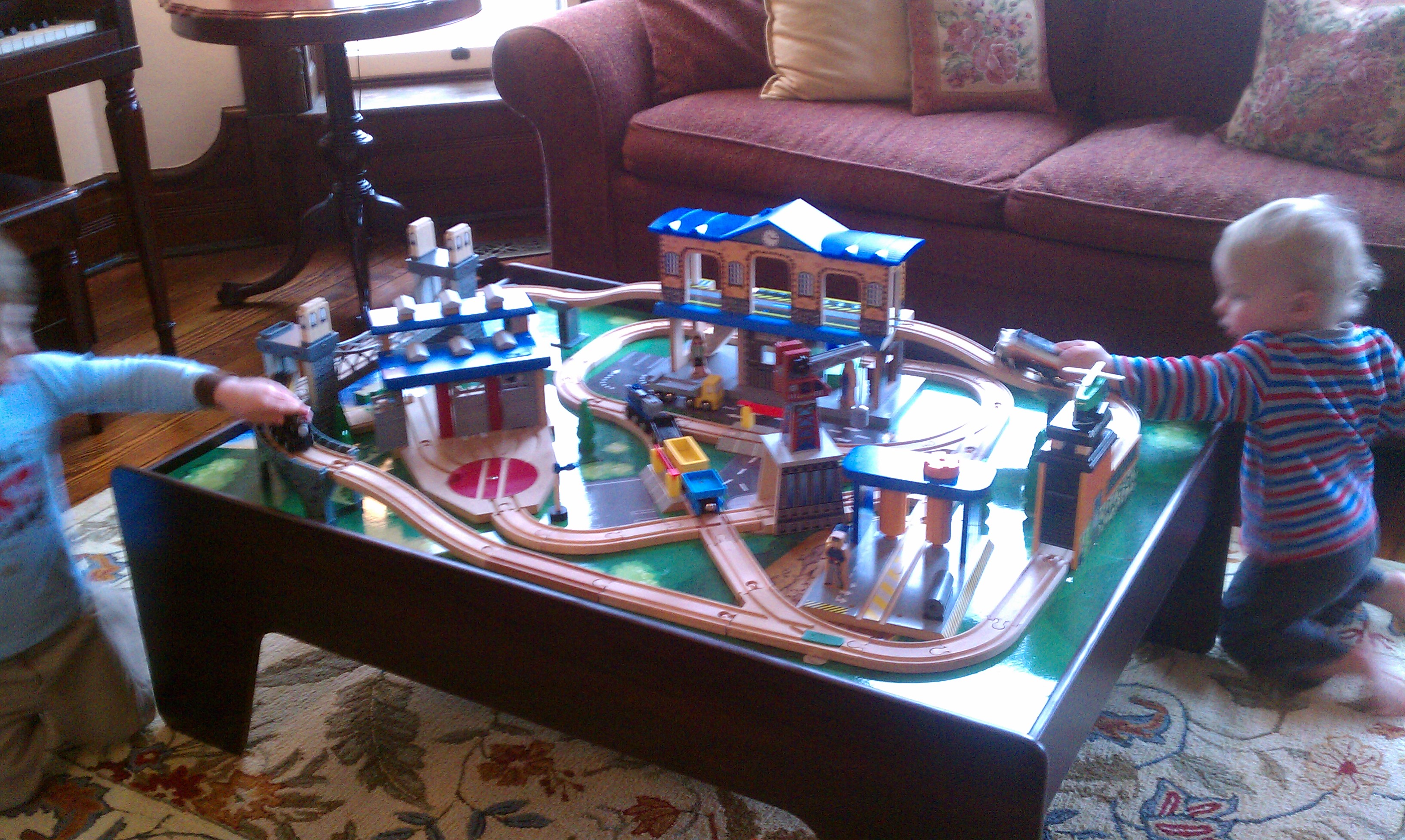
But I have these two adorable little responsibilities, you know? So the closest I get to my fantasy these days is the occasional play-date with a mommy friend, where we maybe fit in a five-minute visit to A Topic of Great Importance, in between our review of developmental milestones, childhood illnesses, and pregnancy experiences (interspersed with admonitions to share and play nicely and not-to-hit-your-brother). If we’re really lucky, we’re drinking a cup of coffee while we chat, sometimes daring to set it down on this lovely table:

Boys and train table

I’m approaching the three-year mark on my role as homemaker/stay-at-home mom, and in that time I’ve (1) spent entirely too much time on Facebook, (2) spoken lots of my political opinions aloud to the radio, and (3) developed wonderful one-sided friendships with a slew of excellent mommy bloggers who don’t even know who I am. I guess that’s the 21st-Century way of socializing a mother of young children, isn’t it? But still, I keep thinking to myself, I want to join that conversation! I want to say something more than what I can fit into a few lines on Facebook! So after almost three years of wanting to blog and thinking I don’t have time to blog and daydreaming topics for blogs and drafting/trashing blog themes, here I am, finally giving it a shot.

As indicated in the subtitle, I intend to blog about some of the goings-on within my own home. But I expect to focus more on the events and ideas and questions that sometimes seem so very far away from the daily tasks of a stay-at-home-mom. (Or this one, at least.) And aside from the physical walls referenced in the blog’s title, I can’t help but think of the figurative walls we so frequently put up between ourselves and others because of our opinions on any number of issues. I plan to explore these in the blog as well.

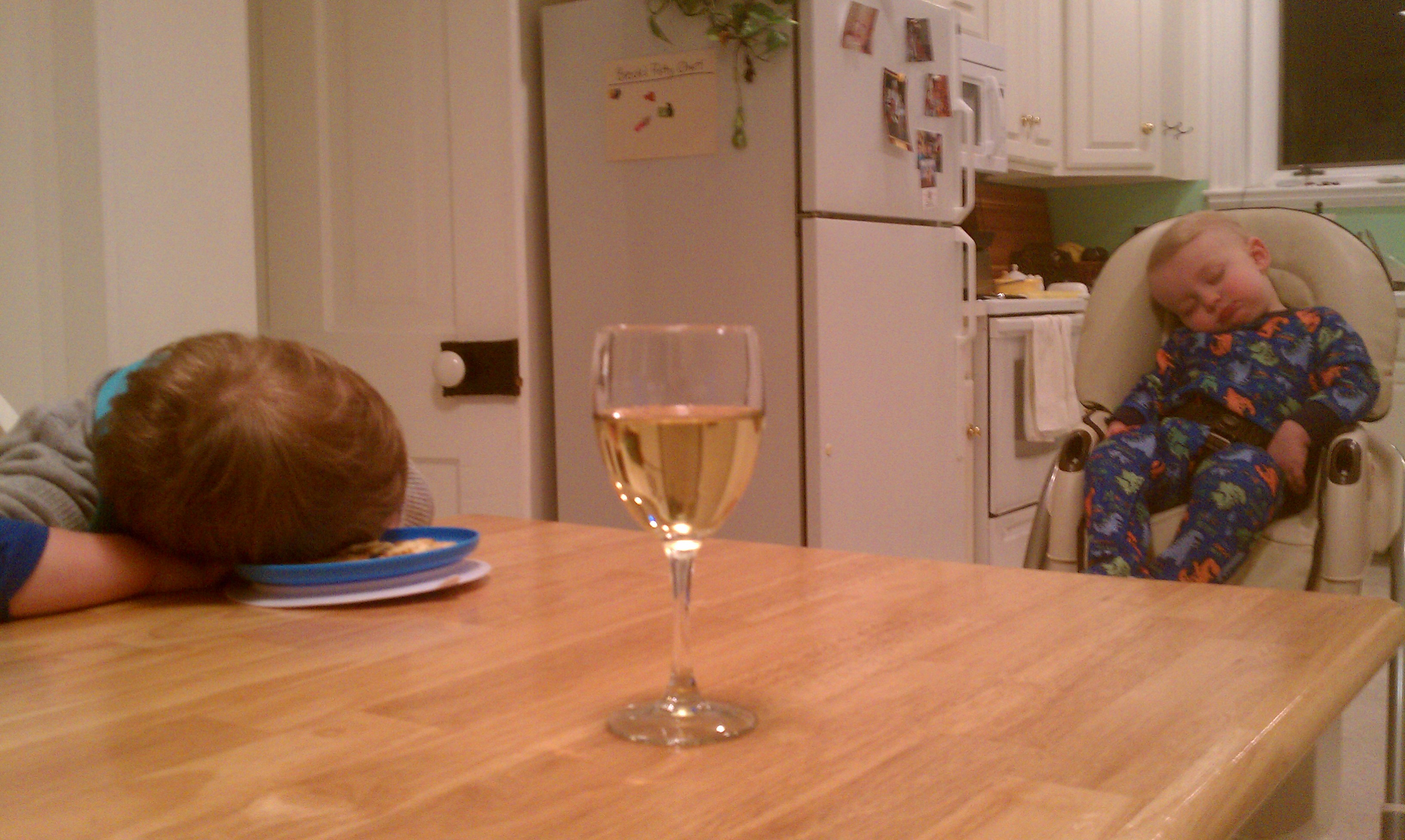
Overall, I’m stuck on that mental image of a cozy venue for deep conversation on those Topics of Great Importance (and also topics of regular importance). I hope this space becomes something like that. And I hope those who participate in the conversation will do so with respect and kindness, a sincere interest in growing in understanding… and maybe a tasty beverage in-hand.

Boys asleep wine on table